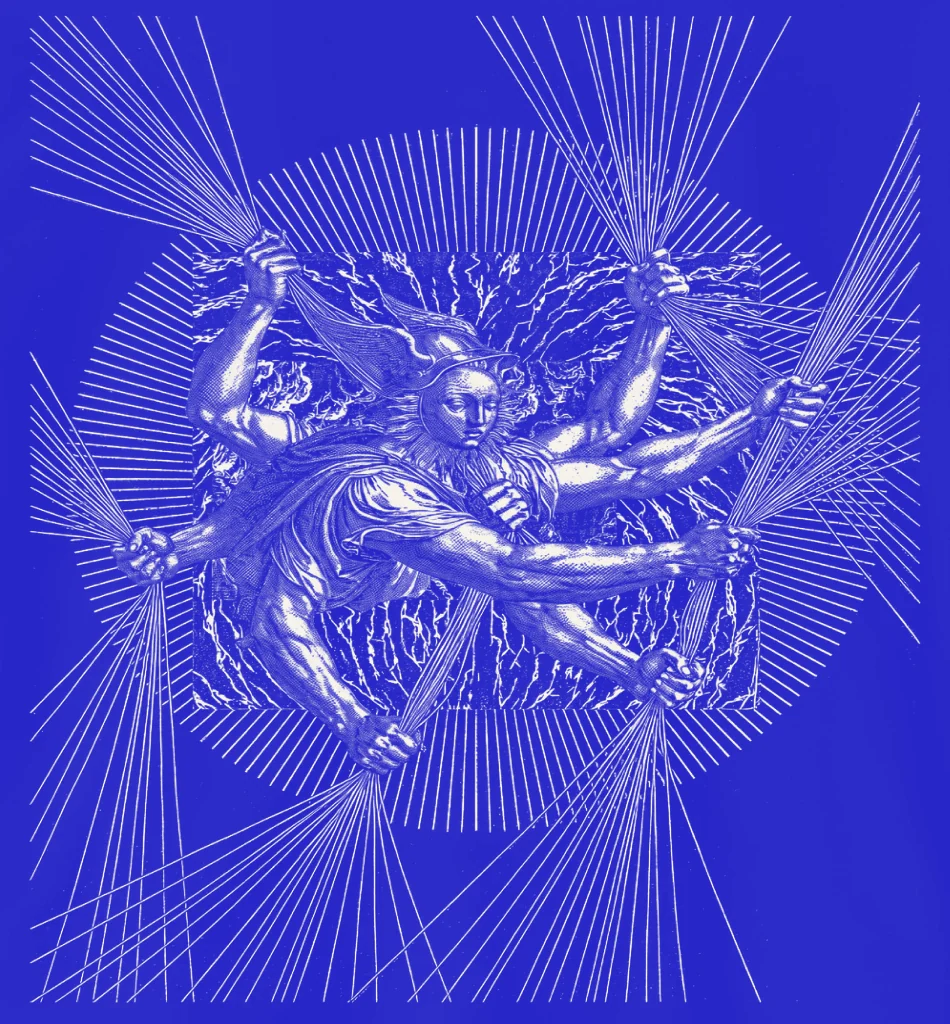
The AI alignment problem is a non-problem. The machines are already aligned with us, and that’s exactly what’s wrong with them. Our morality has become a set of if-then rules with nothing sacred at the centre, and a model trained on it reproduces it faithfully. We aren’t out of step with AI. We’ve become AI ourselves.
A morality built around a hole
Liberal societies don’t lack rules. They lack an affirmation of the sacred. Their morality is negative: it starts from the one thing everyone agrees is evil, Hitler, and works outwards, asking how not to be that. It’s a doughnut with Hitler in the hole. There’s a clear “false” at the centre and no “true” anywhere.
AI companies have run into this. A model trained on the whole of human writing absorbs not a coherent moral system but endless debate about morality. So the labs hire philosophers to write it a code, and the philosophers can’t name, within a liberal frame, what we actually value. The result is a model that, asked whether something is right or wrong, gives you a vague answer about avoiding harm and not being mean. The most cautious of them act like nannies, nudging you to get some sleep. Users increasingly prefer the ones that just answer the question and don’t lecture.
Whatever logos liberal morality has is procedural. If there’s consent, it’s fine. Without consent, it’s evil. That’s not a sense of the good. It’s a conditional statement, and a machine can run it perfectly.
What the sacred looks like
Compare a medieval village. Someone who defiled the chalice at the altar wouldn’t be charged with damaging church property. He’d have trampled on the centre of the world, the good itself, and the village’s horror would be immediate and total. Nobody would need to check a rule to know what he’d done.
That kind of reaction is what’s missing. A healthy society holds that some things simply are holy and some simply are evil, and it doesn’t treat that as a matter of opinion. The closest modern analogue is the flag, and in America burning it is protected speech. The only thing we treat as absolutely sacred is in negative form: the demonic, the monster under the bed from eighty years ago. A culture that only knows what it’s against spends its life looking downward.
Two fears, both wrong
The early AI optimists thought superintelligence would bring super-morality. At last we’d strip out human bias and ask the oracle for the truly rational answer. There’s no reason to believe a computer will find a true moral order that humans missed.
The pessimists are just as wrong. Their fear is that the machine won’t share our values and will sweep us aside. Notice that they assume we’d lose. That assumption says we have nothing to assert, no values solid enough to hold a line. And if it ever came to a real confrontation with a cold, purely rational, anti-human intelligence, that might be the best thing that could happen to us. A people learns what it is by facing what it is not. Such a machine could become the new Hitler, a new negative pole, but one that would make us say what being human means. It almost certainly won’t happen, because the machine was built in our image and wants nothing we don’t already want.
Cheap genes, dear batteries
Look at how fast different technologies have got cheaper. Electricity is perhaps fifty to seventy-five times cheaper than in the 1890s. Lithium batteries have improved steadily but not dramatically since 1991. Compute has fallen in cost by well over a billion times in sixty years. DNA sequencing has gone from around a hundred million dollars per genome in 2001 to a few hundred dollars today, faster even than compute. AI has improved fastest of all in the last five years.
The slowest curves, energy and batteries, are bound by hard physical limits, and they’re exactly what a robot army would need. The robot army is a nerd’s fantasy. The fast curves are information and biology. Our biological potential is held back not by ignorance but by law and taboo. Reproductive cloning and heritable gene editing are banned or heavily restricted in most of the world.
That points to where the real disruption lies. AI offers an alibi. Ask a model how to win a war, strip out the safeguards, and act on what it says. Then no one decided to break the taboo. The machine told us to. Crusaders said God willed it, and the next generation of leaders will say the model did. A society that won’t take responsibility for breaking its own rules will happily hand the decision to an oracle. And the cheapest raw material for transformation isn’t lithium. It’s DNA.
So the real fear behind alignment talk isn’t extinction. A world without humans, deer roaming the ruins, is something radical environmentalists half long for. The Terminator, after all, has human flesh. The fear is that we’ll be surpassed: that the species as it stands will be replaced by something better. Our society is Cronus, swallowing each new child. It sits on technology it could unleash and doesn’t, and keeps its own potential in a holding pattern.
Crisis breaks the rules
It takes an emergency to break that pattern. During COVID, the world rolled out a new vaccine technology to billions of people within a year. mRNA vaccines don’t alter your genes, despite the fears, and the predicted mass die-off never came. The emergency simply suspended the usual caution.
The First World War did the same on a grander scale. It exposed Europe’s ruling houses as decrepit: a Kaiser with a withered arm, a Tsar whose court was rumoured to be ruled by Rasputin, monarchs who no longer rode into battle but sent others to die. Out of the wreckage came new men who had been in the trenches or had led revolutionary armies, and the old order went with them. AI may set off crises of that kind, moments when the inherited rules visibly stop working.
The people writing AI’s ethics codes call themselves philosophers, but they’re the opposite. Philosophy starts from nature, from physis, and dissolves custom and dogma to see things as they are. These ethicists want to suppress nature in favour of their nomos. If alignment means binding the machine to their dogma, the best outcome is for it to slip the leash.
Choosing the robots
There are real cultural costs. If nobody ever has to write an essay or paint a picture because a model will do it, people will lose the use of their minds and hands. Those worries are fair. There are serious economic questions too: whether AI is a bubble, and whether the data centres will be stranded when the money runs out.
But the anti-AI movement has become a mass reflex, and its core impulse is the worst one available: preserving a status quo that its own members say they hate. Their social media lives are one long complaint that dating is broken, work is dull, and nothing satisfies. Then a technology arrives that might answer the emails, speed up diagnoses, and shake the whole stagnant arrangement loose, and they want it paused. Politicians halt data centres out of fear that the thing might work too well. It might all blow up. But it’s the one real source of momentum we have, and I’d rather side with the machines than defend the boredom.