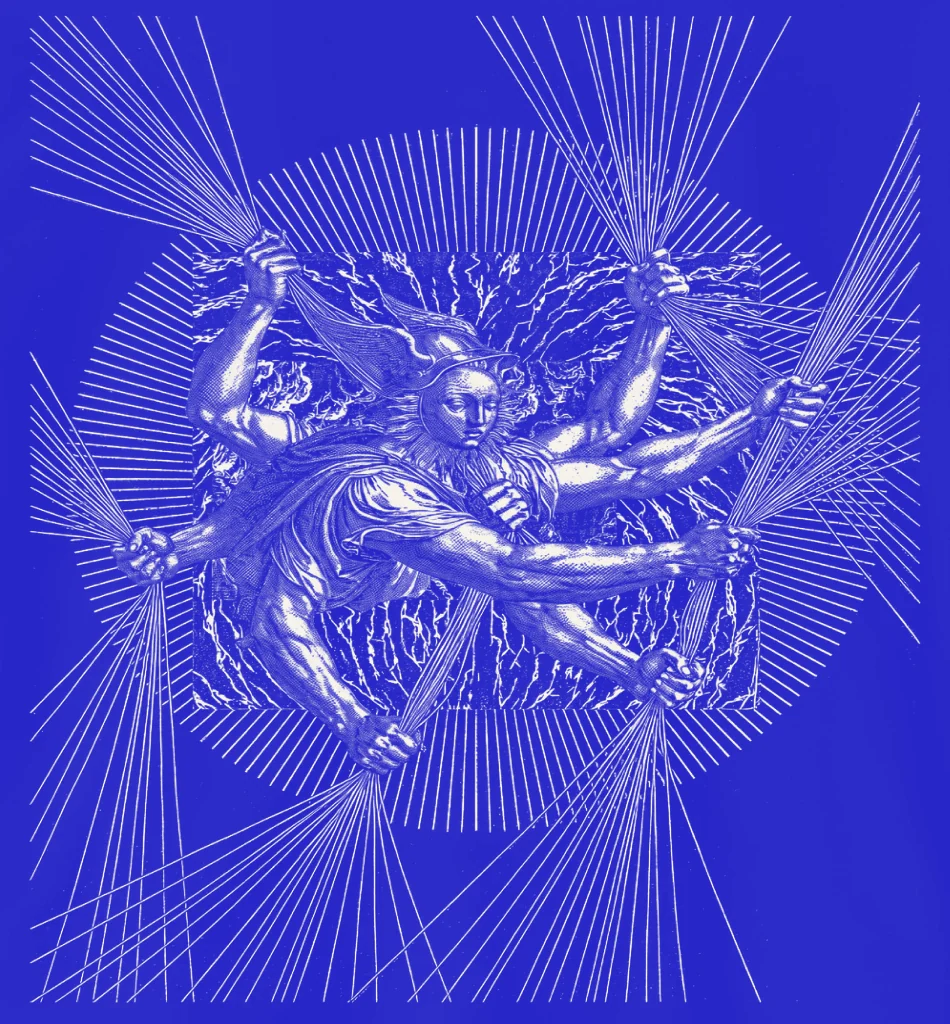
Most of what you think you chose was chosen for you. Your career, your tastes, your hopes and dreams, the jacket you put on this morning and the band you like because it makes you different from your friends: nearly all of it was installed long before you could have weighed it. Of all the theorists of mass society, Louis Althusser explains this most completely. He was a Marxist who wanted capitalism gone, but his account of how a society reproduces itself doesn’t depend on Marxism. It describes every order there has ever been, including ours.
Working by themselves
Althusser saw society as a structure with relatively autonomous levels, the economic, the political, and the ideological, each with its own logic. In the last instance the economy determines the rest. Day to day, though, ideology does the heavy lifting. For people to get up, brush their teeth, and go to work believing they need to, something has to make all of that feel obvious. That something is ideology. In his phrase, individuals “work by themselves”.
His most famous essay, “Ideology and Ideological State Apparatuses” (1970), splits the state’s means of control in two. The repressive state apparatus is everything that runs on the threat of force: the army, the police, the courts, the prisons, and the intelligence services. The ideological state apparatuses are what we’d now call soft power: churches, schools, the media, trade unions, culture, and the family. They don’t coerce. They shape.
Every society needs them, not just capitalist ones. A communist society would have to raise its children as communists. In feudal society the process was easy to see. A peasant’s son was a peasant before he was born, with his whole social role waiting for him. The same thing happens now, just less visibly. A middle-class child is raised to have middle-class hopes, take a middle-class path, and become a good middle-class citizen. Althusser thought that in modern capitalism the school had taken over the Church’s old place as the dominant apparatus, working hand in hand with the family. Together they make the existing order feel like common sense. Of course you wear a uniform and go to school. Of course you work nine to five. What else would you do?
Your hopes and dreams
It goes further than school and work. It reaches what you think, feel, and want. Your hopes and dreams didn’t come from nowhere. They were put there by everything you absorbed from birth: Frozen and Harry Potter, your favourite pop star, the adverts, the playground. You think you express your individual nature when you choose this make-up or that jacket. I’m an individual because I like Pink Floyd, and you’re one because you like U2. Each of those choices reproduces the same core ideology, whether or not the people who made the films and songs knew it. Most ideology works below the level of awareness.
Think of goldfish in a bowl. They have no idea they’re in a bowl. You can see it because you’re outside. Most people inside an ideology can’t see it at all until someone points it out and jolts them.
That applies to everyone, not just the working class. Managers, the upper classes, prime ministers, teachers, and university lecturers are all inside it, mostly without realising. The great irony of Western education is that it teaches this theory and can’t see it. Lecturers explain how ideology reproduces itself while wearing a rainbow lanyard, reproducing the official ideology of their own day as they speak. They’re stuck forever deconstructing the 1950s, when the doctrine is all around them now.
The statue and the water cooler
Althusser defines ideology as the imaginary relationship of individuals to their real conditions of existence. And it isn’t just ideas in heads. It has a material existence.
It’s easiest to see in a cruder age. A statue of a king raising his sword, wearing his crown, is that imagined relationship cast in bronze. Today the university is one. Strictly, it’s a collection of buildings with books and classrooms in them. Everyone there imagines it as a place of learning, and the professor imagines a particular relationship with the students in front of him. Ideology lives in rituals and practices repeated endlessly: the morning assembly, the school bell, clocking in and out, the chat by the water cooler.
Analysis starts by asking what each of those rituals does and what power relations it covers up. Take the big tech campus, with its on-site chefs, meditation rooms, and games consoles. The employee feels special, valued, treated like a person. The relationship is still exploitative, and the perks dress it up. Everyone in the building is still keeping a profit machine running.
Being hailed
Althusser’s key idea is interpellation. A policeman in the street calls out, “Hey, you there!” You turn round. In that moment you recognise him as authority and yourself as the one being addressed. You’ve become a subject.
It isn’t only policemen. You’re hailed every time someone calls you by name, says good morning, or asks how you are. Each time you answer, you accept the whole package: yes, that’s my name, I have this history, I live in this country, I earn this much. In effect you say amen to the reality that’s been built around you. People who recognise themselves in ideology’s call take up their assigned role willingly and reproduce the system from inside, without any need for force.
Everyone believes they’d be the exception. They’re their own man, a free thinker, John Wayne. In practice almost everyone in every time and place answers when hailed. It’s close to impossible to function in a society without accepting your role in it. Subjects experience their own subjection as natural, freely chosen, even pleasant, and that makes ideology far more durable than repression.
In the last instance, there’s still a man with a gun. Step far enough out of line and the truncheon comes down, or the cell door shuts. Most of the time it never comes to that, because you police yourself, and if you don’t, the people around you will. Orwell’s informer and the Soviet or Nazi snitch are the extreme cases. The everyday version is quieter: the raised eyebrow, the change of subject, the friend who brings you back into line. Agent Smith is in everyone.
Paying for the bowl
Capitalism’s best trick is that it does this to people while making them feel they want it. I want to watch this series. I enjoy it. I buy this newspaper every day. From Althusser’s point of view, that’s paying for the privilege of being propagandised.
People see this instantly in others. Guardian readers sneer at people who buy the Sun or the Daily Mail and miss that they’re doing the same thing. Fox News rails against the mainstream media while being one of its biggest channels, and its viewers don’t notice the bubble. Nobody sees themselves in ideology.
Edward Bernays described the same machinery from the inside. He supported the liberal democratic order and taught its invisible rulers to work it better. Althusser described it from the outside, wanting to bring it down. They were describing the same process: ideology frames perception, people take up roles as if they chose them, and those roles come to feel natural.
The illusion of choice
It goes deepest when people identify so completely with their assigned role that it becomes who they are. My name is John and I’m a fireman. I’m Dave, I’m a miner, and proud of it. Whole communities were built on identities like that. Althusser would say the pride is real but so is the arrangement it hides.
Take a professor who insists he chose his life. He chose English at school, English at university, then an academic career. Look at his parents, his schooling, the country and decade he was born into. If it hadn’t been English, it would have been law or finance, something of that kind. The difference is marginal, like choosing between a Mars bar and a Dairy Milk. Your money goes to one company instead of another, and the economic relationship stays exactly the same. It’s a hard thing to accept, but zoom out far enough and most so-called life choices turn out to have been made already.
Why the revolution never came
This leaves Marxism with an obvious problem. If the system reproduces itself so thoroughly, how does it ever fall? How did the Russian, French, or Iranian revolutions happen?
Althusser’s answer, from For Marx (1965), is overdetermination, a term he borrowed from Freud. A society contains many contradictions, at every level. Usually they’re contained. Sometimes enough of them fuse together that the gap between the official story and lived reality becomes impossible to paper over, and enough parts of society stop believing at once that the order breaks. That’s rare, and there are many false dawns.
Seen whole, Althusser’s work on ideology answers the question every Marxist eventually has to face: why didn’t the revolution happen? Marx expected it in the advanced industrial cities, London and Paris. More than a century and a half later, it still hasn’t come. The answer is everything above. Capitalism reproduces itself extremely well, and it’s especially good at selling rebellion back as product.
Picture students on campus taking a group selfie with raised fists on the university mascot. Is anything revolutionary happening? Or are they playing at rebellion, wearing its aesthetics while doing one of the most conservative things imaginable, passing through a factory that trains the capitalist workforce? Where did they end up? Not on the barricades. At Microsoft, Unilever, Google, and the big NGOs.
May 1968 was the grand version. Students rose in Paris, the revolt spread across the West, and people believed the revolution had arrived. It came to nothing. The rebels of 1968 grew up into exactly the comfortable bourgeois the system needed. Helen Andrews’s Boomers follows that generation as it carried its countercultural spirit into the corporation and the institutions, Steve Jobs, Aaron Sorkin, and Jeffrey Sachs among them. They saw themselves as subversives. They became the system’s next generation of managers.
If you doubt any of this, test it. Next time you’re with ordinary people, step a little off the reservation, say one thing that isn’t said, and count how many seconds it takes before somebody gently brings you back.